Dandy Diamonds symbols: what pays, what substitutes and what never pays at all
A board of twenty-five positions holds three kinds of symbol here, and only one of them is in the paytable in the ordinary sense. Sorting them that way is the quickest route to reading a spin correctly, because two of the three most eye-catching symbols on this board do not form a combination of their own at all.
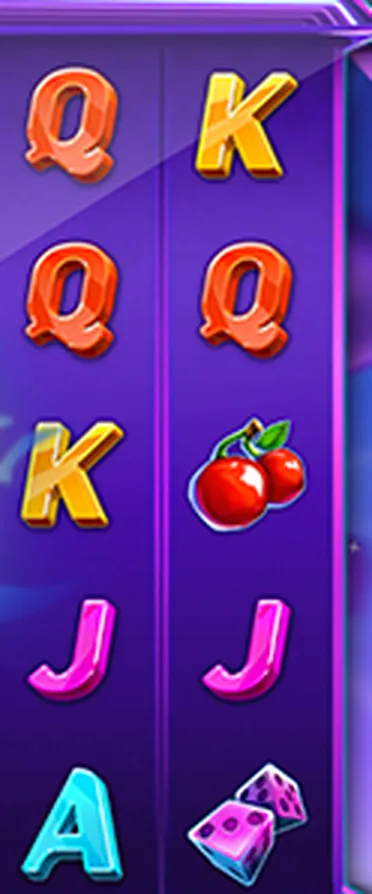
The regular symbols, and what they pay
The paying set is a classic one and the game does not pretend otherwise: royal letters alongside cherries, a lime, dice and jewellery icons including a crown. Our own record of this title names A, K, Q and J, and those are the four the studio's artwork shows. One catalogue extends the royals down to 10 and adds a star to the icons; nothing we hold shows either, so that longer list stays attributed to the catalogue rather than printed here as fact.
Combinations form across 19 fixed lines, paid from the leftmost reel rightwards. Fixed is the word that matters for a reader comparing this with its neighbours on the same shelf: there is no line count to choose, no ways-to-win arithmetic, and no cluster rule. One catalogue hedges on this point and suggests the game may pay by lines or by clusters. It pays by lines, and the figure of nineteen is printed by the trade report and by two other catalogues.
Reading the board by colour
The symbol groups are separated by palette rather than by shape, which is unusually helpful on a square board where several positions can be occupied by one merged symbol. Royals and fruit sit in warm and mid tones, the Diamonds are a cold bright blue, and the Bolt is yellow and white. When a Colossal covers nine positions at once, that separation is the only thing keeping the rest of the board legible.
The Diamond as a substitute
A Diamond acts as a wild and substitutes for all regular symbols in the paytable. That is its first job, and on a spin where nothing else happens it is its only one. Its second job is the multiplier it may be carrying, drawn from 2x, 3x, 4x, 5x, 10x, 15x, 20x, 25x, 50x, 100x, which the artwork prints on the symbol itself so that an enhanced wild is distinguishable from a plain one without opening a panel.
Whether the Diamond also has a pay value of its own is the one place on this page where sources part company. One catalogue states that it pays 20x for five of a kind. The studio's own feature text describes what the symbol substitutes for and what it triggers, and does not give it a line value; our record of this title does the same. So the figure is printed here as that catalogue's and is not folded into anything else on this site.
Why the Bolt is not a pay symbol
The Bolt and the Epic Bolt are the two symbols most likely to be misread, because they are the loudest things on the board and they never pay. A Bolt activates only when it lands within a three-by-three square surrounding a Diamond or a Colossal; it then raises the multiplier values inside that square before wins are rewarded, and once the wins have been handled it spins out of the board along with the ordinary paying symbols. An Epic Bolt skips the proximity condition and acts on every Diamond on the board.
Two consequences follow for anyone reading a spin. A Bolt landing on an empty board does nothing at all, because there is no Diamond for it to act on. And a Bolt that does act changes numbers which are then used by the very next payout, so the board a reader sees when the win is counted is not the board that landed. Only one of each Bolt can appear in a spin, and when both appear the ordinary one goes first.
FS Scatters and what each count opens
The FS Scatter pays nothing and does one thing: it counts. Three landing together open Diamond in the Rough, four open Play with Safire, and five open Ice and Shine, which the studio keeps unannounced in the game itself. Every one of the three begins with 10 free spins.
The same symbol keeps working once a round is running, and the extension rule is the same in all three: two further scatters landing together add two spins, three add four. Because the scatter is the only symbol whose count changes which game is played rather than how much is paid, it is the one symbol on this board where a near miss is a genuinely different outcome and not a smaller one.
Design and theme
The presentation is neon jewellery: a violet and magenta field with floating crystals, a glowing frame around the reels and a chrome-styled wordmark. The studio's own line for the title promises diamonds, jewels and a good deal of glamour, and the symbol set delivers precisely that and nothing stranger — which, for this studio, is itself the notable thing.
The design serves the mechanics more than it looks as if it does. Multiplier labels need to be readable at a glance on a symbol that may be four or nine positions across; Bolt activation needs to be visible as a reach rather than as a flash; and a merged Colossal needs to read as one object rather than as four symbols that happen to match. All three are handled by contrast rather than by animation, which is why the board stays legible at phone size.
The paytable, asked plainly
The rules below come from the studio's own page for the game and from our record of it. Where a value comes from a catalogue instead, the answer names it as a catalogue's.
| Asked | Answered |
|---|---|
| Which symbols pay on their own? | The royals and the themed icons: cherries, a lime, dice and the jewellery pieces. Those form combinations across the fixed lines. |
| Does the Diamond have a pay value? | One catalogue gives it 20x for five of a kind. Our record and the studio page we hold describe its substitution and say nothing about a pay value. |
| Does a Bolt pay anything? | No. It acts on nearby Diamonds, then leaves the board with the ordinary symbols once the wins are settled. |
| Where can scatters land? | Anywhere on the twenty-five positions. The count that lands together decides which of the three rounds opens. |
What those symbols do once they land is on the feature page, and how three of them behave differently inside a round is on the bonus page. The grid, the line count and the rest of the numbers sit on the figures page. The short version is the opening page; the browser build is on the phone page.