Dandy Diamonds slot: one symbol that is a wild, a multiplier and a respin
Almost everything in this game is something happening to a Diamond. It substitutes like an ordinary wild, it can arrive carrying a multiplier, and the moment it lands it starts a respin that keeps it where it is. The merges, the Bolts and all three bonus rounds are variations on those three facts, which is why this page starts with the symbol rather than with a specification sheet.
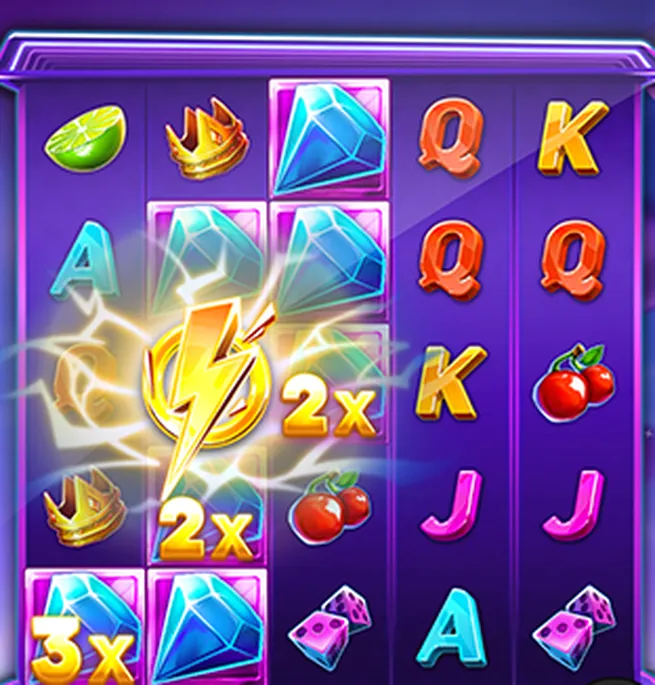
- The shape of the game, in five rows
- Term, value, source.
- In that order, every time.
- Studio
- Hacksaw Gaming
- the studio's own page, our record and six listings
- Board
- five reels, five rows, 25 positions
- counted off the studio's artwork; in words from the trade report
- Lines
- 19, fixed, paid from the left
- the trade report and two listings, not the studio
- Return
- four builds; the operator installs one
- one listing prints the ladder, two others show single rungs
- Ceiling
- 5,000x the stake
- our record, the trade report and six listings agree
Diamond symbols and Dandy Respins
When a Diamond lands it acts as a wild and substitutes for every symbol in the paytable. It may arrive plain, or it may arrive with what the studio calls an Additive Multiplier printed on it. The published set of those values runs 2x, 3x, 4x, 5x, 10x, 15x, 20x, 25x, 50x, 100x.
The respin is the part that makes this symbol unusual. After the winning combinations from the triggering spin have been settled, a landed Diamond starts a Dandy Respin: every Diamond on the board becomes sticky, holding both its position and its multiplier while the remaining positions spin again. Each new Diamond that lands awards another respin and joins the sticky layout. The sequence runs until a respin brings no new Diamond, or until there are no free positions left on the board.
Added together, not multiplied
Wins are awarded after every respin rather than only at the end, so a long sequence pays repeatedly as it fills the board. The word that matters in the multiplier rule is additive: when two or more Diamonds take part in the same winning combination their values are added together first and the total is then applied to that win. A 2x Diamond and a 3x Diamond in one line are worth 5x to it, not 6x. That single word is the difference between a mechanic that compounds and one that accumulates, and it is the studio's own.
Reels, grid and paytable
The board is five reels across and five rows down, which is 25 positions. The studio does not state that in words anywhere we can read, but it ships artwork of the board and the positions can be counted off it; the trade report published when the title went out gives five rows and five reels in writing. The line count is 19, fixed, paid from the leftmost reel, and that figure is the trade report's and two catalogues', not the studio's.
A square board of twenty-five positions is not a decorative choice here. It is the surface the merge mechanic needs: four Diamonds landing in a square corner get to become one symbol, and a board five positions wide and five deep is the smallest one on which that can keep happening at four different sizes. The same geometry is what makes the Bolt's reach meaningful, since a Bolt measures its effect in a three-by-three square around itself rather than along a line.
The paying set
The regular symbols are the classic set: royal letters, cherries, a lime, dice and jewellery icons including a crown. Our own record of this title names A, K, Q and J, and that is what the studio's artwork shows. One catalogue runs the royals down to 10 and adds a star; the artwork we hold shows neither, so the longer list is that catalogue's claim rather than something this page states.
Bolt and Epic Bolt symbols
A Bolt is not a pay symbol. It activates when it lands inside a three-by-three square formation surrounding a Diamond or a Colossal Diamond, and what it does is apply a multiplier value, or raise the ones already there, for every Diamond and Colossal inside that square — before any wins are rewarded. Once the wins have been handled it spins out of the board along with the ordinary paying symbols. Its values are 2x, 3x, 4x, 5x, 10x, 15x, 20x.
The Epic Bolt carries the same set of values and drops the geographic condition entirely: it activates whenever it lands while there is any Diamond on the board at all, and it applies to every Diamond and Colossal in view. Only one Bolt and one Epic Bolt can land in the same spin, and when both land the ordinary Bolt activates first and the Epic Bolt follows. That order is stated by the studio and it is not cosmetic: the Epic Bolt is raising values the Bolt has already raised.
Three bonus rounds, and why they are three games
Three, four or five FS Scatters landing together open a different round each. All three start with 10 free spins and all three extend the same way — two further scatters add two spins, three add four — which is exactly why it is tempting to describe them as one bonus at three sizes. They are not.
Diamond in the Rough, on three scatters, keeps the base game as it is and raises the chance of a Diamond landing. Play with Safire, on four, switches the respin off: Diamonds and Colossals no longer trigger anything, they simply stay stuck where they land for the whole round, and their multipliers hold their value until a Bolt raises them. Ice and Shine, on five, is the hidden one and runs the second round's rules with a three-by-three Colossal guaranteed on the opening spin.
Length is not the difference
So the difference between the first and the second is not length but whether the board resets. In the first, a sequence of respins builds and then ends; in the second, nothing is ever cleared and the round is one long accumulation. Treating them as sizes of the same thing gets the second one wrong in the way that matters most.
The return is a ladder, not a number
Six separate pages print 96.33% for this title and one of them calls that figure the default configuration. A seventh prints the whole ladder: 96.33%, 94.26%, 92.26%, 86.32%, with the operator choosing which one it installs. Two independent things confirm that the ladder is real rather than one page's invention. A British operator publishes 94.26% in the terms attached to its own copy of the game, and another operator's free round for this title is served from an address whose game identifier ends in 94.
Names this title gets mixed up with
The name of this game belongs to it: there is no famous film, no card, no band and no piece of hardware wearing it, which is unusual on this shelf and makes the title easy to look up without a qualifier. The confusion that does exist is entirely inside the studio's own catalogue, where several releases begin with the same letters — Danny Dollar, Donny and Danny, Donut Division among them — and at least one of them is built on the same square board with the same line count.
That matters because a figure read off the wrong card will not look wrong. A ceiling, a line count or a release month taken from a sibling title will slot into a sentence about this one without any of the usual signs that something is out of place, and the only defence is to check that the page a number came from is about this game and not about the one next to it in the same list.
The predecessor, and what not to borrow from it
One catalogue goes further and calls this title an extension of the studio's earlier Ultimate Slot of America, whose ceiling it gives as twice this one's. Treat that as a family resemblance rather than a source of numbers: the Bolt is described by that same page as the new part, and a new part is exactly where two titles stop sharing a specification. No figure from any of those games has been used anywhere on this site.
Free demo, and what this site is not
Several catalogues run a free round of this title, and one of the largest of them says plainly that this game can be played for free there — which is worth noting only because the same catalogue says the opposite about other titles. Whether a free round opens is a property of the site a reader lands on, and sometimes of where they are, not a property of the game.
This site runs none of them and links to none of them. There is no game window here, no demo button dressed up as one, and no download: the title is one HTML5 build in a browser, on a desktop and on a phone alike, so anything offered as an installer for it is something else. The only outgoing link on this page is the operator button in the header, and it goes to a gambling site where the game is played with money.
Common questions about this title
Short answers, each one limited to what a named source actually says. Where the honest answer is that sources disagree, it says so instead of picking one.
| Asked | Answered |
|---|---|
| Who made Dandy Diamonds? | Hacksaw Gaming. The studio's own page for the game carries the feature text, and the trade report on release names the studio too. |
| What does a Diamond do? | Three things at once: it substitutes for every pay symbol, it can carry an additive multiplier, and landing one opens a respin. |
| What is the RTP? | There is no single figure. One listing prints four builds an operator chooses between, and a British operator publishes the second of them in its own game terms. |
| How much can it pay? | 5,000x the stake. This is the one headline number our record, the trade report and every listing we hold agree on. |
| How many bonus rounds are there? | Three, opened by three, four or five scatters. They are different games rather than three lengths of one game. |
| Can I play it here? | No. This site runs no game, opens no free round and holds no balance. The only outgoing link is the operator button at the top. |
The machinery is taken apart on the feature page. The paytable, and the three symbols that never pay at all, are on the symbol page, and the three rounds are told apart on the bonus page. Every number this site prints, with the name of whoever published it, is collected on the figures page, and the browser build is covered on the phone page.